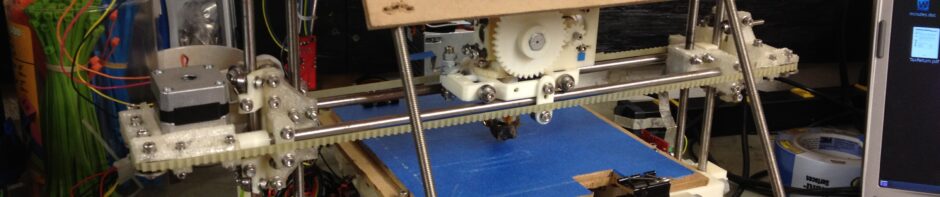
Something’s wrong here, and I’m not sure what it is. There are a bunch of things it could be, and I’m frustrated.
Tonight, again, I watched the MakerBot plastruder push the heater barrel right out of another PTFE insulator.. First it had extruded a small amount, then the entire barrel pushed out. I should create a gallery of PTFE insulators..
I was just ready to print out the test piece that I’d read about for months. I had just tightened up all of the belts, and I was convinced everything was going to work great.
Unfortunately, the barrel is now caked in this seemingly unremovable glaze that’s practically filled the grooves to the point where it seems smooth, which is why it’s not getting a grip anymore. Actually, I don’t know that. I suspect the thermistor is giving inaccurate results, but I’m not sure which way. When I saw it push out, I’d told it to be at 220C. If it was actually colder than that, the plastic would have been tougher to push through the nozzle so the motor would have pushed the heater barrel out (I DID see it extrude some through the barrel, so at least some of it melted). Or it could be way hotter than that, and have affected the PTFE. I don’t know.
I’m burnt for a while. This is extremely frustrating. The extruder needs to be strong as steel, and there needs to be some ability to detect when we’re pushing waaay harder than we should need to, so firmware can stop the motor before it tears the extruder apart. I’m tempted to use some of my Mendel supply of brass rod and PTFE rod to create another extruder from scratch (and use kaptan tape instead of fire cement, since that’s what the MakerBot’s extruder uses), but then I also have to use more nicrome wire, which I don’t have too much of. Agh.
Frustrated. Hulk mad. RepStrap no work. 🙁
[Update: Before giving up for the night, I clamped the existing heater barrel down in a vice, and successfully ran an M6 die from my new metric tap & die kit along the barrel, completely cutting away all of that awful glaze. Later I plan to cut off another piece of PTFE, drill it on both sides, use the M6 tap, and rebuild the insulator again. I do not plan to turn anything on though until I can find our meat thermometer, borrow one from a friend, or buy one at the store, so I can see what temperature the barrel actually is when I tell it to go to 220C.]
Pingback: Suggested Internet site
Pingback: head to Intimatefriend
Pingback: shield control cable
Pingback: Recommended Online site
Pingback: about his
Pingback: check out this one from Businessdaily
Pingback: Lovesomething's website
Pingback: click through the following article
Pingback: simply click the next website page
Pingback: simply click the next document
Pingback: writes in the official Onefinething blog
Pingback: over here
Pingback: a cool way to improve
Pingback: please click for source
Pingback: just click the next web page
Pingback: read full article
Pingback: Suggested Reading
Pingback: Calmlife published an article
Pingback: look at this now
Pingback: click through the up coming web site
Pingback: i loved this
Pingback: just click the up coming document
Pingback: Truereason.click published a blog post
Pingback: go to this website
Pingback: go to website
Pingback: her latest blog
Pingback: find more
Pingback: hop over to this web-site
Pingback: Recommended Internet page
Pingback: please click the next website page
Pingback: navigate here
Pingback: hottips.click
Pingback: visit Lovesomething`s official website
Pingback: Onefinething official
Pingback: simply click the following post
Pingback: low voltage duplex power cable
Pingback: intimatefriend.click
Pingback: mouse click the next web page
Pingback: low voltage power line
Pingback: relevant internet site
Pingback: go now
Pingback: More Support
Pingback: her explanation
Pingback: Source Webpage
Pingback: just click the following web page
Pingback: single wire electric
Pingback: just click the up coming article
Pingback: please click the next page
Pingback: read this blog article from 9signal
Pingback: relevant web site